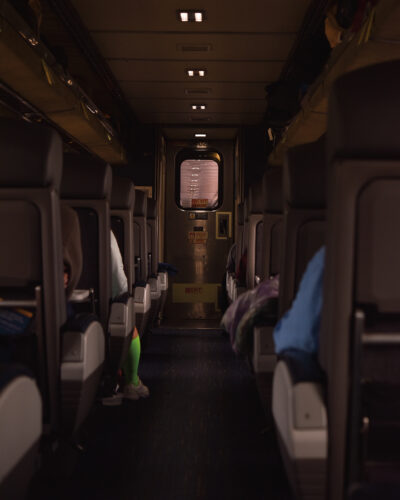
On the platform at Denver Union Station, the low hum of the Amtrak locomotive seems to travel through the tracks and into the feet of the passengers waiting to board. There’s chatter in line, bags at their sides, and the unmistakable energy of people about to go somewhere. Inside, wide reclining seats, footrests, tray tables, and air conditioning await. The conductor comes over the PA. The California Zephyr is leaving Denver.
Eventually, the train will reach Emeryville, California, the end of its three-day journey from Chicago. But this stretch, from Denver through the Rocky Mountains and on to Grand Junction, is arguably its showstopper. The California Zephyr follows a route through Colorado that cars simply can’t, slipping into remote canyons, tracing the Colorado River, and offering a front-row seat to some of the state’s most dramatic landscapes. It does all of this very slowly. And that, you quickly realize, is part of the appeal.
Meet Your Conductors
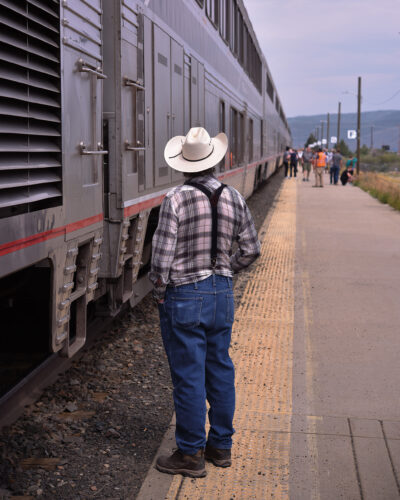
Today’s conductors are Chris Lopez and Johnathan Porter, and they have distinctly different approaches to the microphone. “Chris is more colorful than me; I’m a little more straightforward. I’ll make some jokes, but not like him,” Johnathan says. “I’m a full-time train conductor, part-time philosopher, and out-of-work comedian,” Chris says. “I’m a giver; that’s what motivates me in life.”
Chris started out as an intel officer in the military, and after returning from active duty, family connections helped him break into the rail industry. Twenty years later, he has seniority and an impressive knowledge of this stretch of the California Zephyr. He also has jokes.
Not long after the train leaves Denver, the PA crackles to life. “To the passenger who lost the $200 cash in the blue rubber band,” Chris announces, “we found your rubber band.” It’s part of what makes traveling by train different. The conductors aren’t simply moving passengers from point A to point B. On this route, they’re part tour guide, part host, part entertainment.
A Colorado native, Chris considers this section of track the scenic apex of the journey. As the train passes through the 6.2-mile Moffat Tunnel, he runs “Rock Talk,” a recurring lesson on the history of the area and the landscape unfolding outside.
Why Take the Train?
Ask around, and nearly everyone aboard has a different answer. Kevin Naylor is from England but now lives in Australia. Retired and traveling the world for two and a half years, he’s spending 30 days of it aboard Amtrak, using a month-long rail pass to explore major U.S. cities. “It’s a cheap way of travel,” Kevin explains, “and you spend a few nights sleeping on the train when it could be $200 for a hotel room, so the ticket actually pays for itself.”
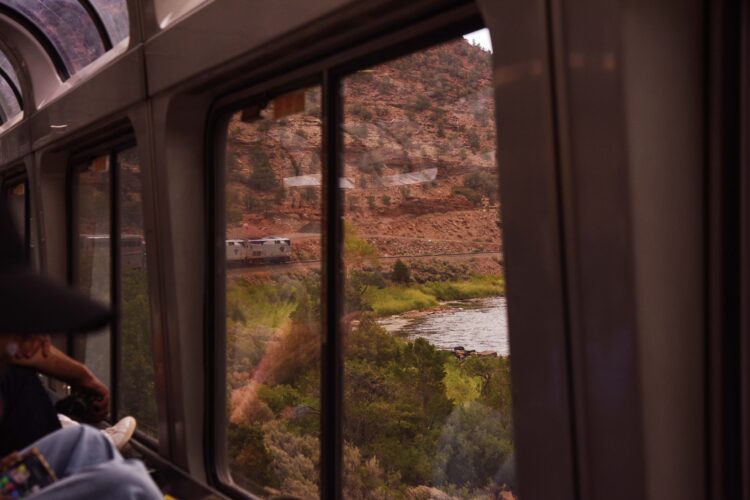
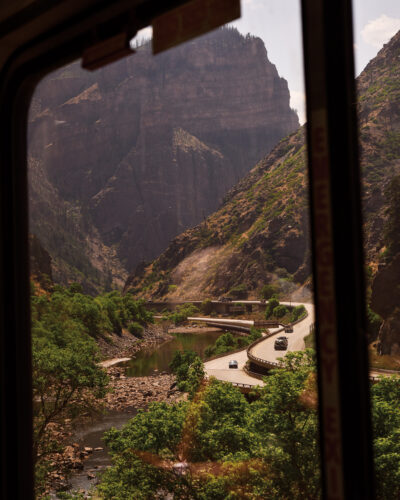
Kevin has made similar trips by bus and car, but the train gives him something different. “But the roads don’t go the same route… It’s a little bit more remote, that’s amazing.” That remoteness is one of the biggest reasons to take the California Zephyr through the Colorado Rockies. Unlike I-70, the tracks carry passengers through places largely inaccessible by road. The train snakes past steep rock walls, dense vegetation, the Colorado River, and stretches of backcountry most travelers would otherwise never see.
Kevin talks with wonder about crossing the country by rail, from the backcountry between San Diego and Sacramento to the jagged peaks of the Sierra Nevada and the canyons of central Colorado. He’s also become acquainted with life aboard the train, including the food. “There’s a few things that I’ve had, there’s a few things I will have,” Kevin says. “I quite like the food.”
Lunch With a View
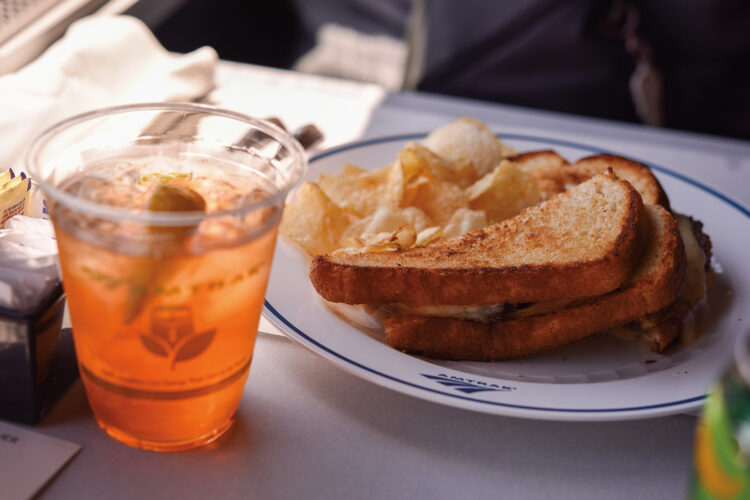
The dining car isn’t trying to reinvent American cuisine, nor should it. There’s something fitting about eating a patty melt while the American landscape rolls past your table. Mark Mutzbauer and his wife, Tina Weller, are doing exactly that. They’re traveling from Chicago to Grand Junction and have already worked their way through much of the menu. Mark hates flying, and neither wanted to make the drive, so they booked a sleeper car instead. “It’s a lot more soulful,” Mark says. “You get to see things at ground level.”
It’s their first time traveling this route, and while neither denies the cost of upgrading to a sleeper, they appreciate having options. “We can sit in our own private car and have a snack, or we can join the others.”
In the dining car, joining others is part of the experience. To maximize space, parties are combined in booths, and at this particular lunch, Mark and Tina share their table with Kimberley Brodnicki from Buffalo.
Kimberley is traveling with her husband, and the train was something of an experiment. “When I’m driving, I just go as long as I can; I don’t want to stop,” Kimberley says. “We were doing it because it would be an adventure and we would see the landscape.” She gets both. She also gets a lesson in one of Amtrak travel’s less romantic realities: delays.
About That Schedule
Near Glenwood Springs, maintenance on the Union Pacific-owned tracks brings the train to a halt. Add trespassers along the route and weather-related speed restrictions, and the California Zephyr eventually falls about four and a half hours behind schedule. Kimberley has a flight to catch. She misses it.
Therein lies one of the most important things to know before taking Amtrak from Denver to Grand Junction: This is not a trip for anyone in a hurry. Driving the route takes roughly half the time under normal conditions. Train delays are common, and booking an important flight immediately after your scheduled arrival is an act of optimism. The California Zephyr makes far more sense when the journey itself is part of the vacation.
Also on board is a café stocked with road-trip classics like ramen, frozen burritos, and M&M’s. Even here, personality comes standard. “It’s Burger King style, so you can have it your way. You give it legs, I give it life, meaning you’re gonna select what you want, bring it to me, and I’ll heat it up for you. Come on down!”
The Best Seat in the House
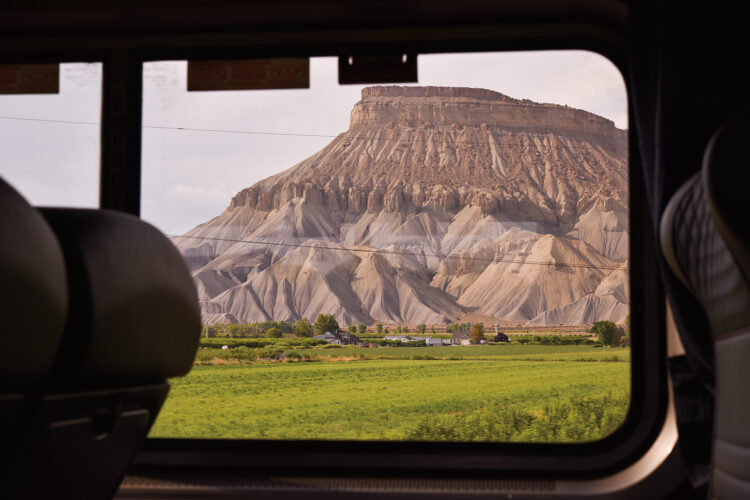
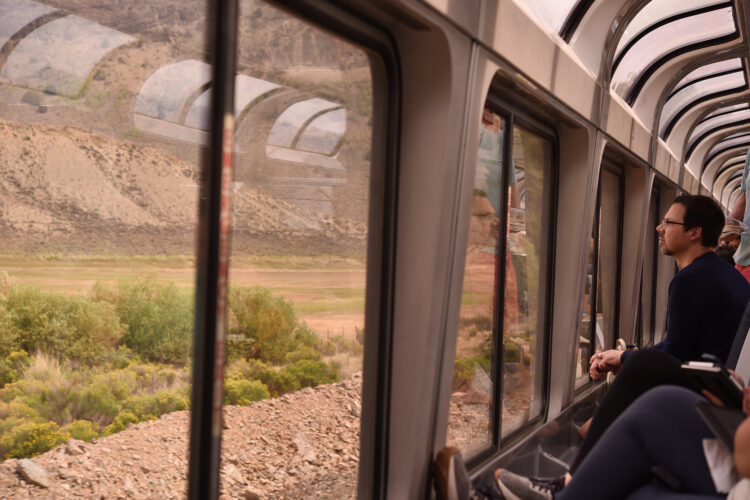
The observation car is where the California Zephyr really makes its case. Floor-to-ceiling windows curve overhead, turning the train car into a moving panorama. Card games unfold in the booths. Strangers trade travel stories. Someone spots an animal, and suddenly half the car is looking in the same direction.
Professor Paul Bischoff has just flown in from upstate New York and is preparing to hike 160 miles of the Continental Divide Trail. Renting a car didn’t make sense, so he boarded the train and will get off in Granby before making his way to Grand Lake.
Ellen Curran is visiting from Florida with her husband on their way to Salt Lake City and Moab. He usually drives on road trips, which means he rarely gets to enjoy the scenery. Here, both of them can stare out the window. Their current debate is which side of the train has the better view.
Then there’s Jacob Miller, a cabinetmaker from Arthur, Illinois, who boarded with a group of 10 people he has traveled with since he was a teenager. He’s now in his 70s. Miller is Amish and has traveled the country almost exclusively by mass transit. This is his third trip to Colorado, every one of them by train and with the same tight-knit group of travel companions.
Mixed among them are seasoned Amtrak travelers trying a new route, a father and son on a “guycation,” and a grandmother making the short hop to Granby to see family. The reasons for boarding vary, but the scenery is a common denominator.
Colorado From the Tracks
The Moffat Tunnel is only the beginning. The 6.2-mile passage beneath the Continental Divide takes about 10 minutes to cross. The Big Ten Curve and Coal Creek Horseshoe showcase the engineering required to move trains through this landscape.
Much of the journey follows the Colorado River, with rocky mountain wildlife appearing sporadically along the way. Near Dale, Colorado, the train passes a stretch Chris calls Eagle Alley, known for bald eagle sightings. Bears occasionally appear along the route, too.
In the coach car, Amanda Rothansel watches for wildlife with her sisters. She’s traveling from Nebraska to Grand Junction to celebrate her divorce, a “freedom trip,” as she calls it. “This way we can all look at the scenery,” Amanda says. “We relax, somebody else drives us.” The sisters scan the riverbanks and eventually spot an eagle. Later, Chris announces that there’s a baby bear on the left bank. All three search the underbrush, but the bear has already disappeared.
There are other wildlife sightings of a distinctly human variety. Along the Colorado River, some rafters participate in a tradition affectionately known as “moon river.” As the train passes, these rugged outdoorsmen drop their pants and shake their assets at those looking out the window. The reaction inside the observation car is reliably mixed: laughter, confusion, and the rapid covering of children’s eyes. It’s difficult to imagine the same scene unfolding on I-70.
The Case for Going Slow
The California Zephyr has a culture of its own. Passengers move aside for one another in the narrow aisles. Speakerphone conversations are frowned upon. Much of the journey through Colorado’s remote canyons has little cell service, and Wi-Fi isn’t something to count on. For some travelers, that’s an inconvenience. For others, it may be one of the best parts of the trip.
Without a screen demanding attention, there isn’t much to do except talk to the person sitting across from you, play cards, read, watch for wildlife, or simply look outside. And there is plenty to look at.
Tens of thousands of people may travel I-70 through the mountains on a given day. The California Zephyr carries only a fraction of them, following tracks that reveal a Colorado largely hidden from the highway.
Nowhere is that clearer than Gore Canyon. The canyon walls rise so high and steep that it’s difficult to take them in at once. There are no roads here. The river below is navigable only by highly experienced rafters, and a distant trail offers one of the few other ways into this landscape. Inside the observation car, the chatter fades. Everyone looks out the window. It happens again in Glenwood Canyon, around Grand Mesa and Ninemile Mountain, and at points all along the California Zephyr route. For a few moments, a train full of strangers falls quiet together.
There are plenty of practical reasons not to take Amtrak from Denver to Grand Junction. You’ll likely leave earlier and arrive later than you would by car. Delays happen. You won’t have a vehicle waiting at your destination. Convenience is not the selling point.
But somewhere deep in the Rockies, with nothing to do but watch a part of Colorado you couldn’t see from the interstate pass outside the window, the reason for taking the slow route becomes remarkably clear. Getting there was the point all along.
For print-exclusive stories, download the digital magazine or pick up a copy from select local King Soopers, Safeway, Tattered Cover, or Barnes & Noble locations.